



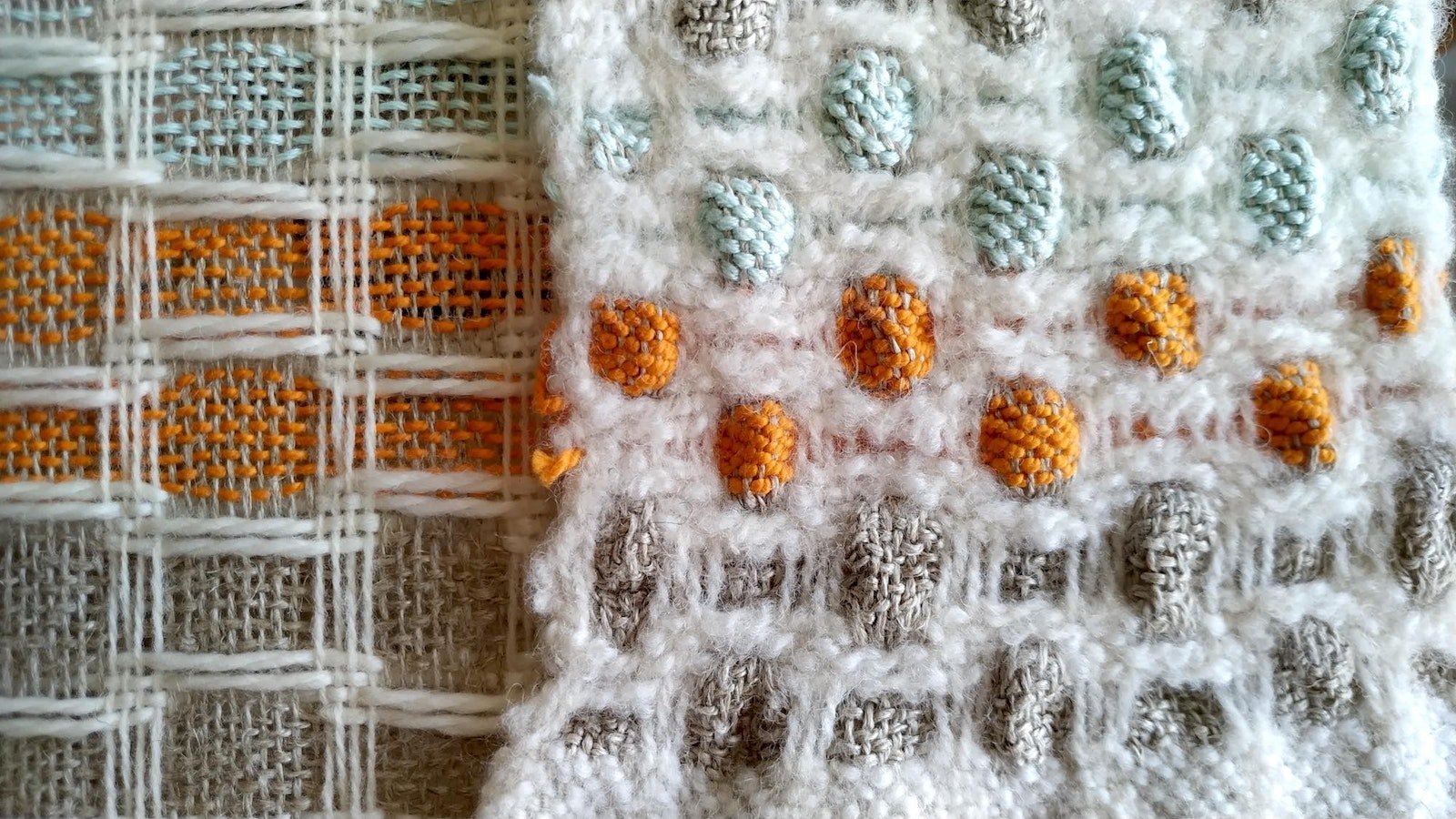
One of the many reasons I love my job is that there’s always something new to learn. For example, in the Spring 2026 issue, I learned three new techniques for weaving beautiful patterns on three different looms: rigid-heddle, pin, and inkle. Each of these techniques builds upon familiar structures and patterns, so even though they are new to me, they still feel completely approachable, and in some cases, beginner friendly.
Easy (Yes Really!) Deflected Doubleweave
I’ve long loved deflected doubleweave and even woven it a time or two on my eight-shaft loom. While I knew it was technically possible on the rigid-heddle loom, the only rigid-heddle project I’d seen using the structure (Elisabeth Hill’s Taconic Tonic Scarf) involved two pick-up sticks and three pick-up sequences. The project is absolutely gorgeous, but it requires a level of concentration rarely possible in a house with two small children.
Imagine my surprise when I learned from Petra Marciniak that deflected doubleweave doesn’t have to be complicated. Not only does she weave it regularly on the rigid-heddle loom, but she also does it without a pick-up stick! I was skeptical at first, but after reading her article, I had my mind blown multiple times—her clever method is also shockingly simple. I would consider it slightly more complicated than plain weave.
As if that weren’t enough, Petra combines her weaving method with differential shrinkage to create cloth that literally pops (after wet-finishing)—you can see exactly what I mean in the photo at the top. You can learn more about this incredible technique in her article “How to Weave Curves and Bubbles,” starting on page 6. While it’s not a project, you’ll learn everything you need to know to confidently start weaving deflected doubleweave on the rigid-heddle loom.
Slide Weaving
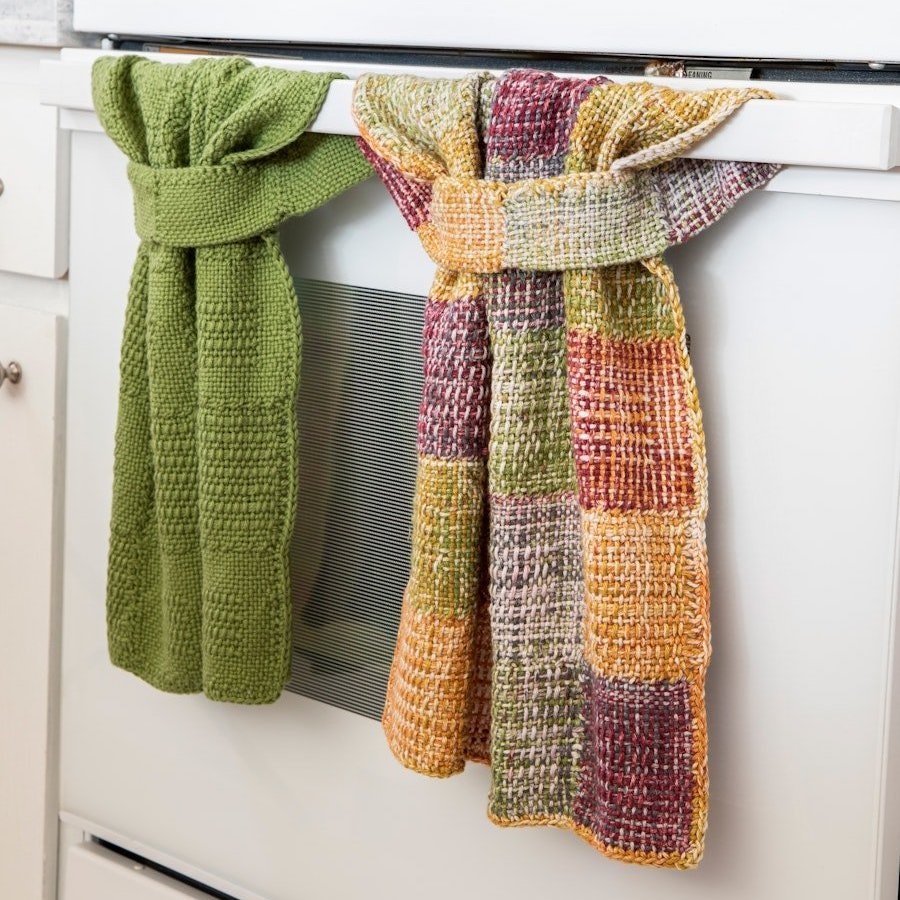
For her Fields from Afar Dish Towel, Deborah Bagley created her beautifully textured cloth using a slide-weaving technique. Photo by Matt Graves
Whether you call it pick-up, needle weaving, or pattern weaving, creating textured cloth on pin looms can sometimes be a literal pain. Weaving through three layers of yarn sometimes requires brute force that can leave your wrist and hand feeling sore. In her Fields From Afar Dish Towel, Deborah Bagley uses a different approach to weaving textured cloth. Instead of always going over or under all three layers of yarn, she sometimes slides her needle between layers.
For her towel, Deborah uses inelastic cotton—a fiber that doesn’t always play nice on the pin loom. With the slide technique, which she learned from Licia Conforti, Deborah was able to weave patterned squares much easier than with traditional techniques. Seeing how well it worked on cotton, I’m now curious about using it with linen, raffia, and other finicky fibers.
Wavy Bandweaving
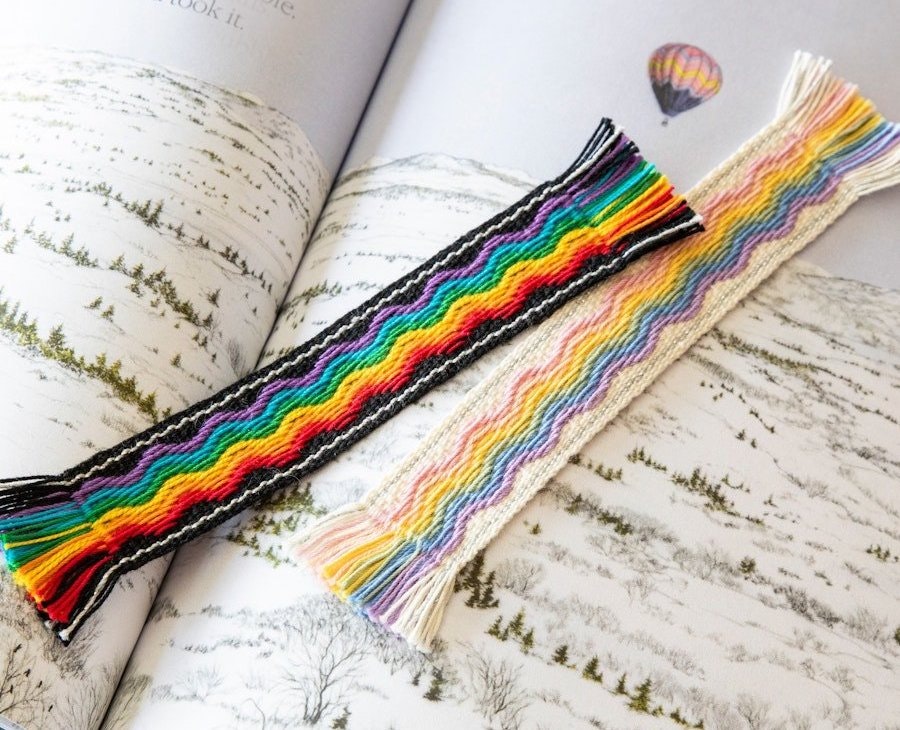
The colorful waves in Kris Katkus’s Shimmering Rainbows project were made using a multicolor pick-up technique. Photo by Matt Graves
When I saw Kris Katkus’s Shimmering Rainbows project for the first time, I had to know how she was able to weave such beautiful multicolored waves. While I’m no stranger to pick-up on the inkle loom—I’ve played with Baltic-style and alternating pick-up—this felt like something different, and I had to learn more.
As it turns out, Kris used a variation on three-color pick-up, a technique that is itself a variation of Baltic-style pick-up. With this technique, you can switch back and forth between different colors of pattern warp to create incredible, complex, and colorful designs—including Kris’s wavy rainbows! While I wouldn’t recommend this technique to beginning inkle weavers, it’s perfect for experienced weavers who love pick-up and want to find new ways to explore color and pattern in bandweaving.
Room to Grow
Personally, I can’t wait to play with all three of these techniques in my own weaving. If you feel similarly inspired, please know that I’d love to see what you make! (Even better, if you end up using these techniques in your own original designs, consider submitting them to a future issue of Easy Weaving with Little Looms.) No matter what, I hope you enjoy the Spring 2026 issue and feel just as inspired by the articles and projects as I do.
Happy Weaving!
Christina